Social Intelligence
Finds topics, questions, myths, competitor comparisons and discussion spikes. Shows where to respond, where to observe and where a human should step in.
A platform of transparent AI personas, ambassadors and community agents for social networks, media, owned channels and internal simulations. The agents listen to the market, answer the audience, explain products, correct myths and test messaging before it goes public.
AIV shows what AI says about your brand. Influence Agents manage how your brand speaks through AI.
Behind every AI persona sits a managed layer of data, passports and checks.
Finds topics, questions, myths, competitor comparisons and discussion spikes. Shows where to respond, where to observe and where a human should step in.
Creates AI persona passports: role, disclosure, owner, knowledge base, channels, autonomy level, memory rules and kill switch.
An internal agent team moves through scout, context, research, persona writer, policy/brand review, human approval and publish/evaluate.
Controls disclosure, platform rules, claims, provenance, audit trail, similarity/flood control, crisis mode and persona quality.
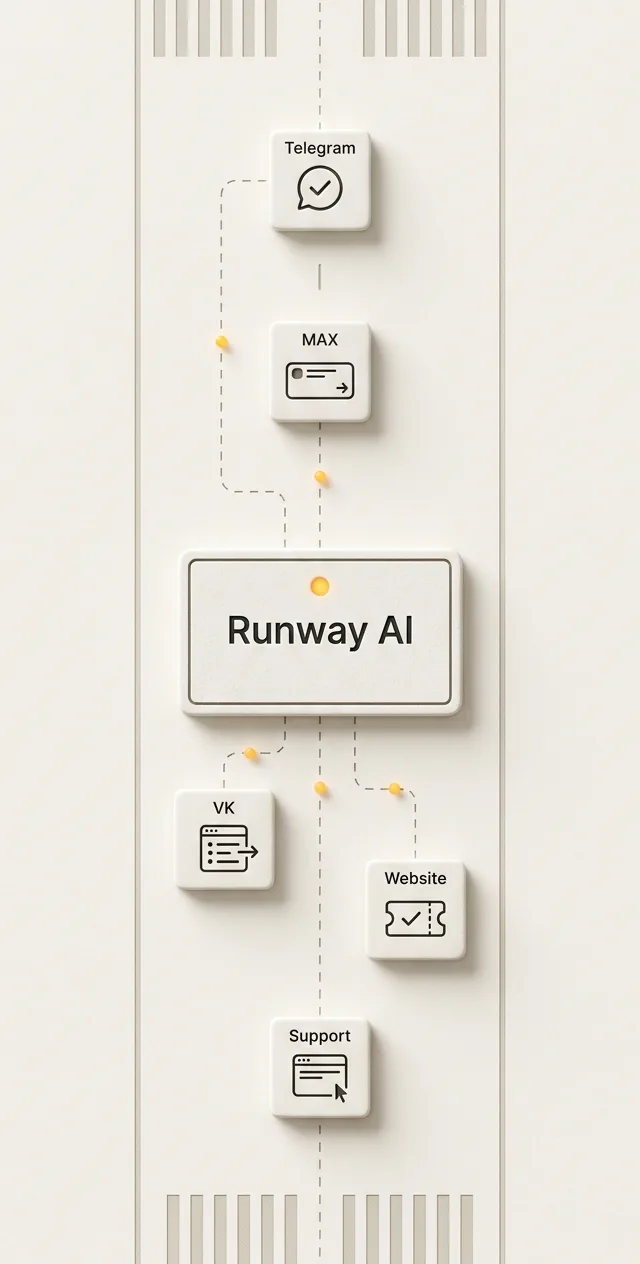
Disclosed AI agents for owned channels, Telegram/MAX, websites, helpdesks, comments and official social channels. They answer questions, explain the product, keep the conversation going and escalate complex cases to a human.
Monitoring for topics, questions, myths, objections and competitor comparisons. It shows where a response opportunity appears, where risk is growing and where a conversation gives product or marketing insight.
An archetype builder and synthetic audiences. Before publication you can test a message, price, landing page, FAQ or crisis response on simulated segments.
A trust management layer: disclosure, approval workflow, audit trail, provenance, platform policy matrix, claims checker, similarity limits and crisis mode.
By default a persona introduces itself as an AI brand representative, virtual consultant or synthetic analyst.
Sensitive topics, crisis scenarios and questionable claims go to human approval.
The system shows who created the persona, which sources are connected, who approved an action and why the agent proposed a response.
AI media carries origin labeling, and assets keep links to sources and rights.
Every channel has a mode: read-only, draft-only, human-approved, owned-channel autopilot or simulation-only.
A persona, campaign, client or channel can be stopped immediately.
The swarm architecture stays internal: what goes public is an official human, a brand account or a disclosed AI persona.
Find relevant discussions, questions, complaints, myths and buying signals.
Collect thread, channel, history and platform-rule context.
Verify facts against the knowledge base, website, FAQ, client documents and permitted sources.
Prepare a reply or material in the role of a specific AI persona.
Check disclosure, claims, brand voice, PII, toxicity and manipulation risk.
A human approves, edits or rejects the action.
Publish in an allowed mode and collect outcomes, complaints, helpfulness and insights.
These are a pilot evaluation system and a future dashboard, not already proven results.
Share of relevant conversations found and classified.
Where a reply is useful, risky or better avoided.
How fast the team receives a usable first draft.
How often a human approves the draft without major edits.
Share of replies supported by sources.
How consistently AI disclosure is respected.
Policy violations, complaints, flags and risky claims.
Number of useful product, marketing or support insights found.
Helpfulness or CSAT in owned and support channels.
An AI persona replies in an official Telegram chat and on the website, handles recurring questions, collects FAQ topics and escalates complex cases to a human.
The platform finds persistent product myths, verifies facts against sources and prepares careful replies for a human or disclosed AI persona.
Before launch, a campaign is tested against synthetic segments: skeptics, early adopters, competitor users and enterprise buyers.
No. The external product is built around disclosed AI personas, official channels, approval workflow and audit trail. Undisclosed scenarios are limited to safe contexts: simulations, research and neutral monitoring.
In owned channels, Telegram/MAX, the website, helpdesk, CRM, official social channels and permitted monitoring sources. The mode depends on platform rules and topic risk.
Yes. The starting mode should be draft-only or human-approved. Autopilot belongs only in owned/support channels and must include escalation.
Website, FAQ, documentation, product descriptions, helpdesk, CRM, policies, forbidden claims and brand voice.
In one bounded area: owned community support, social radar + response copilot or synthetic audience lab. Success metrics and autonomy limits are fixed before launch.
We start with one bounded scope: choose a channel, connect knowledge, set disclosure rules and define success metrics. If the product is not useful for your scenario, we will say so before launch.